
Linton Hall City Directory Collections
The historical directory shelf for Linton Hall sits at the county level, chiefly at Prince William Public Libraries' Ruth E. Lloyd Information Center, known as RELIC. The verified city-directory runs are a 1960-83 and 2001 Manassas-area set, plus a 1963-80 corridor set for Quantico, Dumfries, Triangle, Marumsco, Woodbridge, and Occoquan. They are useful leads, not a complete municipal roll. Linton Hall can appear under county, Manassas-area, Bristow, Gainesville, a rural route, or another nearby label.
RELIC also holds telephone books that reach well beyond the city-directory years. Those runs include 1903, 1941, 1951, 1958-59, 1966-71, 1973, 1975, 1977-78, and 1980-current Prince William County volumes, with a 1965-66 Quantico and Marine Corps Schools volume. The Roots in Prince William guide verifies these local holdings but does not identify a single publisher for the county runs. Treat the listed dates as available collection points, not proof that every intervening year survives.
| Collection layer | Verified run | Keeper | How to use it |
|---|---|---|---|
| Manassas-area city directories | 1960-83; 2001 | RELIC printed and microform collections | Look for a name, address, or nearby geographic label. |
| Corridor city directories | 1963-80 | RELIC printed and microform collections | Use when a Linton Hall search points toward the broader corridor. |
| Prince William telephone directories | 1903; 1941; 1951; 1958-59; 1966-71; 1973; 1975; 1977-78; 1980-current | RELIC | Check subscriber and address continuity. |
| Local News Index | Since 1993; some obituaries from 1970 | RELIC | Find a notice, relationship, or later trail endpoint. |
There is no verified Linton Hall-only publisher series or named Linton Hall sample entry in the available library material. The break between the 1983 and 2001 Manassas-area volumes is a collection gap, not evidence that a property stood empty. Ask RELIC staff whether a related telephone, street, or reverse volume covers the target year before drawing a conclusion.
RELIC's Linton Hall Directory Shelf
RELIC is the county's local genealogy and history room. Its staff materials list hours of Monday, Wednesday, and Thursday from 10 a.m. to 4 p.m.; Tuesday from 1 to 7 p.m.; and the first and third Saturday from 10 a.m. to 4 p.m. The listed staff phone is 703-792-8150. Bring the person’s name, an approximate year, every known address spelling, and alternate place names. Ask first for the directory format that fits the question, then for microfilm, finding aids, or a related telephone volume.
The RELIC resources page describes a much wider research shelf, including census tools, historical newspapers, family histories, maps, and licensed databases. Some licensed resources require an in-library session or library-card authentication. That matters when a directory gives only an initial or rural route. A census image, obituary, map, or yearbook can supply the separate detail needed to tell similarly named households apart.
See the RELIC genealogy resources that support a Linton Hall directory search.
Library access is especially useful when the needed directory is a printed volume, microform item, or a resource that requires in-library use.
Linton Hall Historical Place Clues
Historic Prince William provides context that a directory rarely carries: cemetery mapping, historic-place material, the 1972 county street map, photographs, diaries, and farm or place stories. Its inventory specifically references Linton Hall deed-book 142-336, map-book 9-43, the Linton Hall Cemetery, the convent at 9535 Linton Hall Road, and the relocated Clark-Jones cemetery. These references are starting points for a record-book or cemetery inquiry, not a ready-made chain of identity.
The Linton Hall place name is older than much of the current development. Historic material can refer instead to Broad Run, Bristow, Gainesville, Manassas, a farm, or a rural route. Search those names beside the surname or road, then compare the result with a directory date and the legal description in a deed. The same road may retain a familiar name while the postal or administrative label changes around it.
Explore the Historic Prince William collections for local context behind a Linton Hall directory entry.
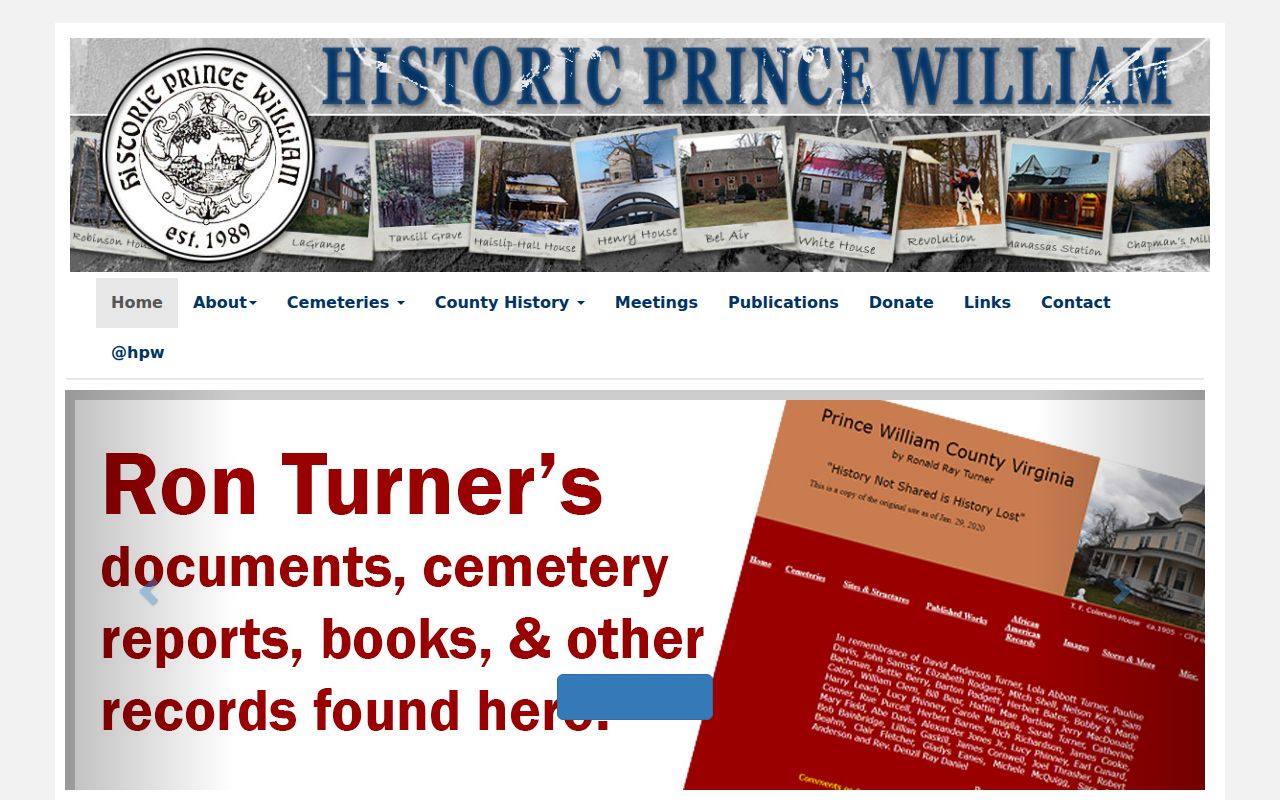
The historical society’s material helps connect a directory address to the landscape, cemetery, map, or place name that may appear in older sources.
Reading Linton Hall City Directory Entries
A directory entry is an inventory to inspect, not a standardized form. In the locally documented genre, a line may show a surname and initials, street address or rural route, spouse or widow notation, and an occupation or business affiliation. It may also send the reader to an alphabetical, street, classified, or telephone section. No named Linton Hall entry or exact abbreviation key was found in the static sources, so every mark below is a possible field rather than a guarantee.
Record where the item sits before copying a name. Note the volume year, page, and whether the entry came from an alphabetical or street section. Preserve variant spellings and initials. A new resident, non-subscriber, rural household, person using a different surname, or person with an unlisted number may be absent. An absence therefore needs a check against the nearest surviving volume and another record type.
| Placement | Volume year, page, and alphabetical or street section. |
|---|---|
| Name | Surname plus given name or initial, with variant spellings worth preserving. |
| Address | Street number, street name, or rural route as printed. |
| Household clue | Possible spouse or widow notation when that volume uses it. |
| Status clue | A possible abbreviation or cross-reference, to be checked in that volume’s key. |
| Other field | Possible occupation or business affiliation, when present. |
- Criss-cross section
- An address-first section that arranges entries by street and house number rather than by surname.
- Householder index
- A name-based listing of household heads or listed adults, depending on the particular volume.
- Abbreviation key
- The volume’s own explanation of shortened words and symbols. Check it before interpreting a mark.
Linton Hall Directory Archive Companions
The RELIC Digital Archives do not substitute for every printed directory, but they provide strong companions for a dated name or place. Its historical material includes Prince William deeds from 1731-1827, tax and rent rolls from 1738-1784, PWC People 1701-1865, school and map collections, photographs, and vital compilations. Those collections can explain an older county place name or connect a household to a surviving historical record.
The Local News Index is another useful companion. It begins in 1993 and includes some obituaries from 1970, although the index is still a work in progress. A news or obituary hit may identify kin, an address, or a cemetery lead. Follow the index to the underlying item when possible, and treat printed notices as historical context rather than proof of a present address.
Open the RELIC Digital Archives before moving from a Linton Hall city directory lead to older county sources.
The digital archive is best used to add date, place, and relationship context to a directory line, not to assume every volume has been digitized.
Linton Hall City Directory Geography
Linton Hall is a census-designated place and an unincorporated Prince William County community, not an incorporated city. That jurisdictional fact affects every historical city-directory search. Older collections may describe the area through Linton Hall Road, Broad Run, Bristow, Gainesville, Manassas, a rural route, subdivision, or farm name. A directory volume organized around a nearby urban label can still contain a useful lead for the Linton Hall area.
Postal labels are not decisive either. County material connects the CDP with ZIP codes 20109, 20136, and 20155, while Linton Hall Road crosses different postal classifications. Match an old address to its road spelling and era first. For a parcel question, a current GPIN and legal description are more stable bridges than a postal city field. A modern development may also sit on land described in early records by metes and bounds instead of a street number.
Consult RELIC county-record collections when a Linton Hall directory search needs microfilm, maps, cemetery files, or historic land context.
County-record collections supply the geographic context that a broad-area directory title may leave out.
Note: A postal or directory label can guide a search, but the road, parcel description, and source date determine whether two entries refer to the same place.
Linton Hall Directory Trail Workflow
Use directory volumes as dated household snapshots. Start with the closest verified year and a fixed address or surname. A reverse or criss-cross section, if RELIC has one for the target volume, starts with the house number and street, then points to an occupant or subscriber. Check that person in the alphabetical section for spelling, spouse notation, an alternate address, or a cross-reference. RELIC is the appropriate keeper to ask for address-first volumes because no separate official reverse-directory title was identified.
- Write down the street spelling, house number, rural route, subdivision or farm name, and the era being tested.
- Check the street or reverse section first when an address is known, then compare the listed person with the alphabetical section.
- Repeat at the nearest available volume before and after that date, without treating a collection gap as a vacancy.
- Pair the directory year with a federal census year. RELIC lists schedules from 1790-1930, and later releases follow the federal 72-year rule.
- Use the assessor, GPIN, deed index, and plats to test whether a changed address reflects a transfer, subdivision, or road change.
- Close the trail with an obituary, cemetery record, probate or heirs file, newspaper item, or yearbook when the research question calls for it.
A name that vanishes can mean a move, death, alternate surname, unlisted service, or simply an unavailable volume. It does not prove any one event. Pairing a directory with the census, a newspaper notice, cemetery material, and a recorded transfer produces a more reliable family-history timeline than one isolated listing.
Linton Hall Directory Limits
Directories are selective historical publications. A telephone book normally identifies a subscriber or household connection, not all people at an address. A city-directory entry can omit rural households, private numbers, recent arrivals, or people recorded under another name. Census geography also differs from today’s CDP boundary, and historic records may use older county descriptions. Keep each source’s year and geographic label with the result.
For a volume that does not answer the question, move through the documented fallback chain: ask RELIC for the correct print run, microfilm, finding aid, or related telephone book; consult Historic Prince William for place and cemetery context; then use the Library of Virginia or National Archives for archival material. The Historical Commission preserves local history resources but is not a resident database. Respect privacy and use historical material for lawful family, estate, or place-history research.